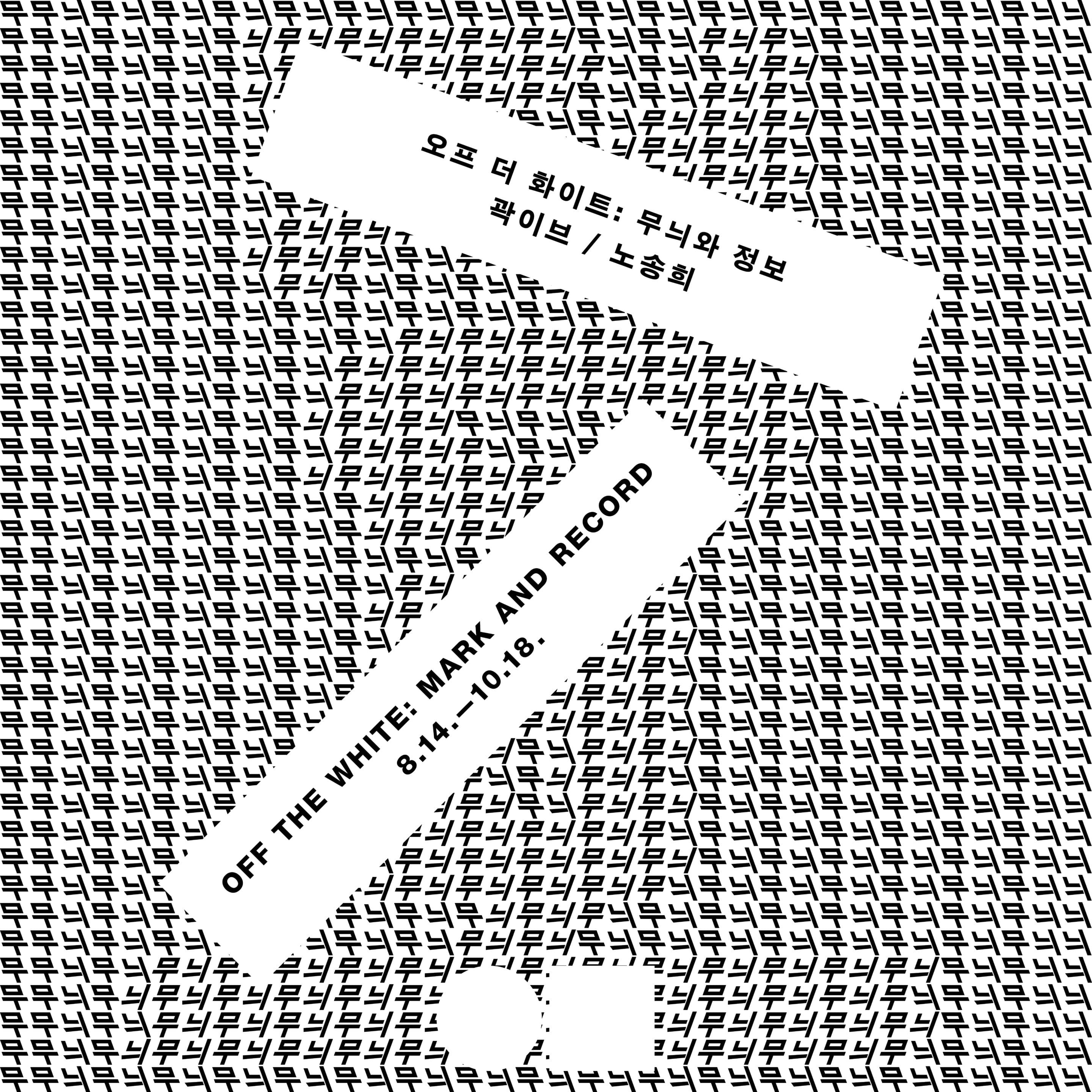
오프 더 화이트
《오프 더 화이트》는 건축 100주년을 맞은 일민미술관이 ‘미술관’이라는 장소에 관한 동시대 미술의 실험과 전망을 탐색하는 릴레이 전시이다. 1926년 동아일보 사옥으로 지어진 이곳은 근대 언론의 업무 시설에서 출발해 광범위한 시각문화 현상을 다루는 기관으로 변모했다. 오늘날 이 자리에 위치한 미술관은 그러한 배경 위에 흰 전시실을 세우고, 작품을 배치하고, 담론과 이미지를 생산한다. 이때 미술관은 단순히 예술품이 적재된 공간의 의미를 넘어 작품이 새롭게 인식되고 재구성되는 곳이다.
통상 미술에서 ‘장소’가 대체할 수 없는 특정성을 지닌 현장으로 받아들여지는 것과 달리, 《오프 더 화이트》는 모종의 개입이나 틀로 명명되는 장소 이전의 것, 어떤 곳이 특정한 곳으로 호명되기에 앞서 미술관을 작동시키는 다른 차원의 조건에 주목한다. 이를테면 벽과 바닥, 빛과 장식, 보관과 운반의 규칙, 진열과 감상의 태도, 비물질적인 느낌이나 습관 같은 부산물들이다. 이러한 요소에 주목해 온 작가들은 미술관이 중립적인 백색 환경과 ‘특정 장소’ 사이에서 예술 작품의 힘과 감각을 협상하는 특수한 자리임을 드러낸다.
무늬와 정보
곽이브는 일민미술관의 벽을 무언가 새겨진 원판으로 삼아 그 표면을 새로운 정보가 발생하는 장소로 바꾼다. 〈태극기와 모기장〉은 작품을 걸고 내리는 일이 반복된 벽면에 도배지를 바른 뒤, 벽을 받아 적듯 탁본하는 한편 미술관 바깥을 관찰해 얻은 형상을 그려 나간 작업이다. 접촉을 통해 떠오르는 흔적과 손의 움직임을 통해 기입되는 이미지가 겹쳐 무늬가 되고, 전시실이 축적한 시간뿐 아니라 이곳을 둘러싼 권위나 정동 또한 무늬의 일부를 이룬다. 곽이브는 굴곡이 없는 개념적인 평면을 실제로 만질 수 없는 요철을 지닌 일종의 깊이처럼 다루어 왔다. 그에게 무늬는 무언가를 지시하거나 환원하지 않은 채 표면을 읽게 만드는 형식과 같다. 곽이브는 개인전 《이사24》(2024), 《흰머리》(2017), 《면대면 시공-건축 프로젝트: 역할》(2017) 등을 열었고, 서울시립미술관, 아르코미술관, 일민미술관 등에서 단체전에 참여했다.
노송희는 일민미술관의 바닥을 유동적인 퍼즐로 바꾼다. 퍼즐은 흩어진 조각을 배열해 여러 장면을 만들 수 있지만, 미리 정해진 조각의 형태와 절단선을 벗어나지 못한다. 작가는 이 구조로부터 과거의 자료를 선별하고 배열해 현재를 구성하는 아카이브의 작동 방식을 보았다. 〈퍼즐〉은 미술관 자료실에서 발견한 기록물을 통해 전시의 역사가 날짜, 예산, 치수와 같은 정량적 체계로 관리되어 왔음에 주목한 작업이다. 알루미늄에 수공적으로 새긴 이미지는 5, 10, 12, 100 등 시간을 구획하고 기념하는 수의 단위와 연결된다. 이러한 무늬는 아카이브의 부정한 면을 보여주는 유희인 동시에 정보 뒤에 숨겨진 노동을 가시화하는 또 다른 정보이다. 노송희는 개인전 《아카이브 모양》(2025), 《DIZZY》(2023)를 열었고, 서울시립 미술아카이브, 제7회 창원조각비엔날레, 베니스비엔날레 한국관 30주년 특별전 등에서 단체전에 참여했다.
기간
2026.8.14.(금)—10.18.(일)
장소
일민미술관 1전시실
주최
일민미술관
후원
한국문화예술위원회, 현대성우홀딩스
참여작가
곽이브, 노송희
관장
김태령
기획
일민미술관 학예실
기획 협력
권정현
진행
문하영
행정 및 관리
최유진, 배진주, 정지은, 이성호
그래픽 디자인
워크룸
사진
스튜디오 오실로스코프
관람시간
화―일요일 오전 11시―오후 7시, 월요일 및 9.25.(금) 추석 당일 휴관
서울시 종로구 세종대로 152
주차공간이 협소하니 대중교통을 이용해 주시기 바랍니다.(동아미디어센터 주차시 10분당 1,000원)
문의 02-2020-2050 / info@ilmin.org
Off the White
Off the White is a relay exhibition through which the Ilmin Museum of Art, marking the 100th anniversary of its architecture, explores contemporary art’s experiments and prospects concerning the museum as a place. Completed in 1926 as the Dong-A Ilbo headquarters, this building began as the offices of a modern newspaper company and has since transformed into an institution engaging with a broad range of visual culture. Against this background, the museum now erects white exhibition halls, places artworks within them, and produces discourse and images. In this sense, the museum exceeds the meaning of a space in which artworks are simply stored; it is where artworks are newly perceived and reconstituted.
Unlike the conventional understanding of “site” in art as a setting endowed with irreplaceable specificity, Off the White attends to what precedes such enunciation in the form of an intervention or a frame. It looks instead to another order of conditions that enable the museum before a given location is called forth as a site. These include the by-products of the museum’s operation: walls and floors, light and ornament, storage and transport protocols, attitudes toward display and viewing, and immaterial registers such as feelings and habits. The artists who have attended to these elements reveal the museum as a singular position where the force and sensibility of artworks are negotiated between a neutral white environment and a “specific site.”
Mark and Record
Kwak Eve treats the walls of the Ilmin Museum of Art as plates already bearing marks, turning their surfaces into sites where new records emerge. In The Korean Flag and Mosquito Net, Kwak applies lining paper to walls bearing traces of artworks repeatedly hung and removed. She then takes rubbings of their surfaces as though transcribing them, while drawing forms derived from observations outside the museum. Traces that emerge through contact overlap with images inscribed by the movement of the hand, producing marks that register both the time accumulated in the exhibition hall and the authority and affect surrounding this place. Kwak has long treated a conceptual plane devoid of undulation as a kind of depth with intangible relief. For her, marks are a mode that prompts a reading of the surface without assigning it an external referent or reducing it to one. Kwak has held solo exhibitions including MoveMove (2024), Gray-White Hair (2017), and Face to Face Construction-Architecture Project: Part (2017), and has participated in group exhibitions at the Seoul Museum of Art, ARKO Art Center, and the Ilmin Museum of Art, among others.
Noh Songhee turns the floor of the Ilmin Museum of Art into a puzzle in flux. A puzzle can produce multiple scenes through the arrangement of its scattered pieces, yet it remains bound by their predetermined shapes and cut lines. In this structure, Noh sees the workings of the archive, where materials from the past are selected and arranged to constitute the present. Puzzle draws on documents found in the museum’s archive to examine how the museum’s exhibition history has been administered through quantitative systems such as dates, budgets, and dimensions. The hand-engraved images in aluminum relate to the numbers 5, 10, 12, and 100, which partition and commemorate time. Taken together, these marks are at once a game that reveals the compromised character of the archive and a record that renders visible the labor concealed behind information. Noh has held solo exhibitions including Shaping the Archives (2025) and DIZZY (2023), and has participated in group exhibitions at Art Archives Seoul Museum of Art, as well as in the 7th Changwon Sculpture Biennale and the special exhibition marking the 30th anniversary of the Korean Pavilion at the Venice Biennale, among others.
Period
2026.8.14.(Fri) ― 10.18.(Sun)
Venue
Ilmin Museum of Art (Exhibition Hall 1)
Organized by
Ilmin Museum of Art
Sponsored by
Arts Council Korea, Hyundai Sungwoo Holdings
Artists
Kwak Eve, Noh Songhee
Director
Kim Taeryung
Curated by
Curatorial Dept. of Ilmin Museum of Art
Curatorial Cooperation
Kwon Junghyun
Coordinator
Moon Hayoung
Administration
Choi Yoojin, Bae Jinju, Jeong Jieun, Lee Sungho
Graphic Design
Workroom
Photography
Studio Oscilloscope
Opening Hours
Tuesday―Sunday 11 AM―7 PM, Closed on Mondays and Sept. 25 (Chuseok Holiday)
DISCOVER SEOUL PASS Partnership
Ilmin Museum of Art 152 Sejong-daero, Jongno-gu, Seoul, Korea